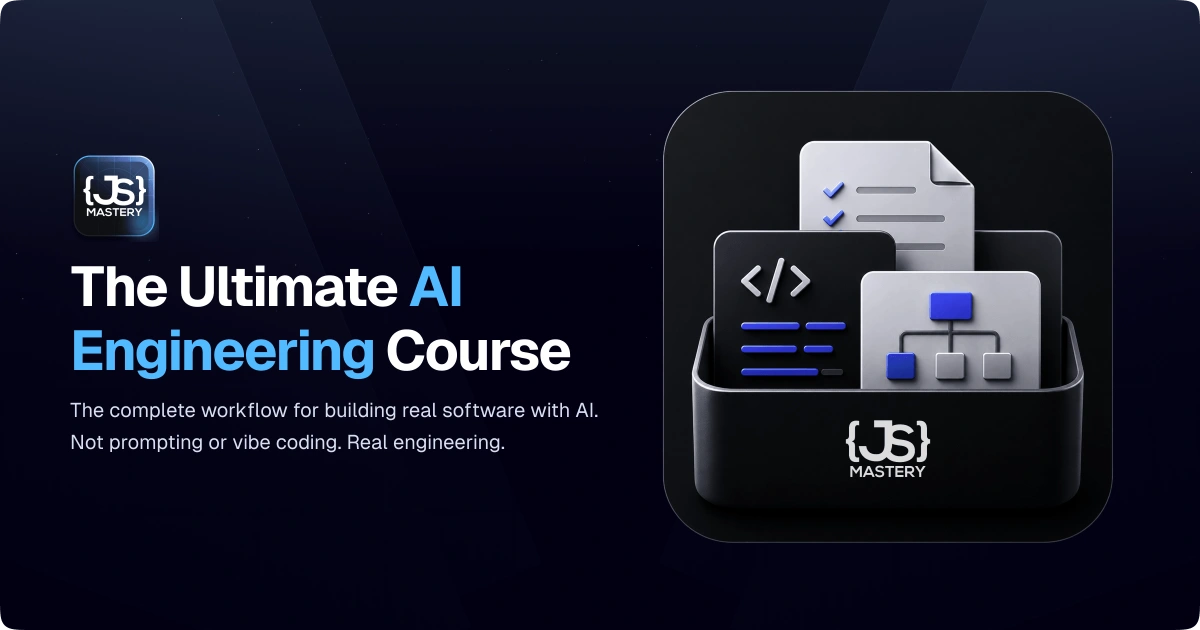
JSMastery – The Agentic Engineering Course
$248.00 Original price was: $248.00.$40.00Current price is: $40.00.
- 24/7 Contact Support & Telegram - Ecomkevin_1
- You Can Request Any Courses
- Original Courses HD Qualite and links updated
Guaranteed Safe Checkout


JSMastery – The Agentic Engineering Course: An Honest & In-Depth Review
The landscape of software development is undergoing a fundamental transformation. Standard full-stack web development, while still essential, is no longer the sole frontier for modern developers. Today, the focus has shifted toward building autonomous systems—applications that do not merely execute deterministic logic, but instead reason, plan, act, and iterate to achieve complex goals. This paradigm is known as Agentic Engineering.
With numerous courses claiming to teach AI integration, Adrian Hajdin’s platform, JS Mastery, introduced JSMastery – The Agentic Engineering Course. Designed specifically to bridge the gap between traditional full-stack web development and modern AI orchestration, this program promises to equip developers with the skills required to engineer real-world, autonomous agentic systems.
In this detailed review, we take a thorough, objective look at what the course offers, its structure, key takeaways, and whether it is worth your investment.
What Is Agentic Engineering?
Before evaluating the course material, it is critical to understand the distinction between basic AI integration and true Agentic Engineering.
Most traditional tutorials show developers how to send a prompt to an API endpoint (such as OpenAI’s GPT models) and render the response on a UI. While functional, this represents a simple request-response mechanism.
Agentic Engineering, on the other hand, deals with systems that operate with autonomy:
-
Perception: Reading user inputs, documents, or environment states.
-
Reasoning & Planning: Breaking complex goals into sub-tasks and determining execution pathways.
-
Tool Augmentation: Allowing AI models to query databases, execute code, perform web searches, or invoke external APIs.
-
Memory Management: Managing short-term working memory and long-term vector-based retrieval.
-
Refinement & Guardrails: Validating outputs, handling failures, and rerouting logic when results do not meet quality benchmarks.
Mastering these concepts requires a solid grasp of software architecture, state management, and modern framework mechanics.
Course Structure and Curriculum Overview
The course is structured to take a developer from fundamental AI concepts to production-ready agentic architectures. Rather than focusing purely on abstract theory, the curriculum relies heavily on project-based learning—a signature approach of the JS Mastery brand.
Module 1: Foundations of Autonomous Agents
The opening modules demystify the core concepts behind LLM architecture and multi-agent interaction. Key subjects covered include:
-
Transitioning from deterministic programming to probabilistic software design.
-
Understanding state machines, loops, and routing in autonomous workflows.
-
Function calling and structured outputs: enforcing deterministic JSON schemas from non-deterministic models.
Module 2: The Modern AI Tech Stack
Building robust agents requires specialized tools and libraries. The course provides practical instruction on:
-
Orchestration Frameworks: Hands-on experience with modern agent frameworks (such as LangChain, LangGraph, or custom light-wrapper state machines).
-
Vector Databases & RAG: Storing, indexing, and retrieving semantic embeddings using modern vector stores like Pinecone, Qdrant, or Supabase Vector.
-
Model Providers: Interfacing with leading LLM APIs, including OpenAI, Anthropic Claude, and open-source models hosted locally or via serverless endpoints.
Module 3: Tool Use and Environment Interaction
Agents derive their power from their ability to interact with external tools. This section focuses on:
-
Equipping agents with REST API access, database readers/writers, and browser automation tools.
-
Building custom tool interfaces with type safety and error-handling pipelines.
-
Handling edge cases where an agent encounters API errors or rate limits.
Module 4: Memory, Persistence, and Multi-Agent Orchestration
Advanced applications often require multiple agents operating in tandem—for example, a researcher agent paired with a writer agent and a reviewer agent. Topics in this module cover:
-
Context window management and dynamic token optimization.
-
Multi-agent delegation patterns and consensus mechanisms.
-
Building durable state systems that persist across user sessions.
Module 5: Production Deployment & Guardrails
A key differentiator of this course is its emphasis on shipping production-level code. Developers learn:
-
Implementing safety guardrails to prevent infinite agentic loops and runaway API bills.
-
Monitoring, tracing, and debugging agent execution paths using specialized telemetry tools.
-
Deploying real-time streaming interfaces using modern React frameworks like Next.js.
Hands-On Projects: Building Real-World Applications
Theory alone is insufficient when mastering AI orchestration. The core value of this program lies in its real-world projects, designed to simulate actual industry requirements.
Project 1: Autonomous Market Research Agent
Students build an agent capable of taking a user prompt, executing dynamic web queries, parsing article contents, cross-referencing facts, and compiling a structured report with source citations. This project teaches the fundamentals of search-augmented generation and autonomous loop control.
Project 2: Multi-Agent Software Development Assistant
This project focuses on multi-agent collaboration. One agent acts as a project manager breakdown expert, another writes code based on specifications, and a third runs validation checks against the output. Students learn how to pass state between isolated LLM instances reliably.
Project 3: Enterprise Knowledge Retrieval System (Advanced RAG)
Moving beyond simple chunk-and-search vector workflows, this project demonstrates advanced Retrieval-Augmented Generation. It covers semantic routing, hybrid search (combining keyword and vector search), and parent-document retrieval strategies to minimize hallucination rates.
Key Highlights: What Sets It Apart
1. Production-First Mindset
Unlike basic video tutorials that write code in isolated notebooks, this course emphasizes production codebases. You write structured TypeScript code with proper error boundaries, state persistence, and clean architecture.
2. High-Quality Production Values
In line with standard JS Mastery releases, the visual presentation, audio quality, and code explanations are clear and engaging. Complex concepts are supported by architectural diagrams before implementation begins.
3. Focus on Developer Experience
The course leverages modern tooling—TypeScript, Next.js, Tailwind CSS, and Server Actions—ensuring that full-stack web developers can integrate agentic capabilities cleanly into their existing tech stacks.
Areas for Improvement
While the course provides tremendous value, there are a few considerations potential students should keep in mind:
-
Pace and Prerequisites: This is not a beginner course for non-programmers. A solid working knowledge of JavaScript, TypeScript, asynchronous programming, and basic React/Next.js patterns is strictly required to keep up.
-
Fast-Evolving Landscape: The AI ecosystem evolves at a rapid pace. While the core architectural principles taught in the course remain timeless, specific API parameters or framework helper functions can undergo deprecation or updates over time.
Who Is This Course Best Suited For?
-
Full-Stack JavaScript/TypeScript Developers: Developers who want to elevate their skill set from building standard CRUD applications to building modern AI-driven platforms.
-
Software Engineers Looking to Pivot: Engineers aiming to position themselves as AI Engineers or Agentic Systems Architects in the current job market.
-
Tech Founders and Solopreneurs: Developers building SaaS products who want to incorporate autonomous workflows to increase user value and automation.
Final Verdict
JSMastery – The Agentic Engineering Course delivers a practical, well-architected roadmap for developers seeking to master autonomous AI development. Instead of offering surface-level API wrappers, it focuses on the underlying principles of state management, tool execution, multi-agent collaboration, and production safety.
For developers with a solid JavaScript/TypeScript background looking to transition into modern AI engineering, this course stands out as an effective, highly structured investment in long-term technical growth.
